
The complete guide
How To Choose And Use A Drain Plunger That Actually Works
The problem with a slow drain
A drain rarely blocks all at once. It starts as a sink that empties a little slower than it used to, a shower tray that holds an inch of water around your feet, or a toilet that swirls for a moment too long before it clears. Most people ignore that stage. Then one evening the water just sits there, and suddenly it is a problem that needs solving before anyone can wash up or shower.
The instinct is usually to reach for a bottle of drain cleaner. That can work, but it is a blunt approach. You are pouring a strong chemical into standing water, waiting, and hoping. If it fails, you now have a blocked sink full of caustic liquid, which is a far worse thing to deal with than a blocked sink full of dirty water. Plenty of plumbers will tell you the same thing: try mechanical pressure first.
That is what a plunger does. It is a simple tool, it has not changed much in a century, and when it is the right size and you use it properly, it clears a surprising share of household blockages in under five minutes.
How a plunger moves a clog
The common misunderstanding is that a plunger pushes a blockage down the pipe. It does not really work like that. What it does is move the column of water in the pipe back and forth.
When you press the cup down, you force water toward the clog. When you pull up, you drag water back toward you. Water does not compress, so all that force transfers directly to whatever is stuck. That back-and-forth rocking breaks up the mass. Hair tangles loosen, grease plugs crack, wads of paper shear apart. Once it is broken into pieces, the normal flow of water carries it away.
This is why the upward pull matters as much as the downward push. People lean on a plunger and shove hard, over and over, and wonder why nothing happens. Short, firm strokes with a good seal beat heavy, sloppy ones every time.
It also explains why the seal is everything. If air can get in around the rim, you are just stirring the water. The pressure escapes sideways instead of travelling down the pipe. A cup that lies flat and wide against the drain surface is the whole game.
Why 140mm is a useful size
Plunger cups come in a range of diameters, and the size you pick decides which fixtures it can handle.
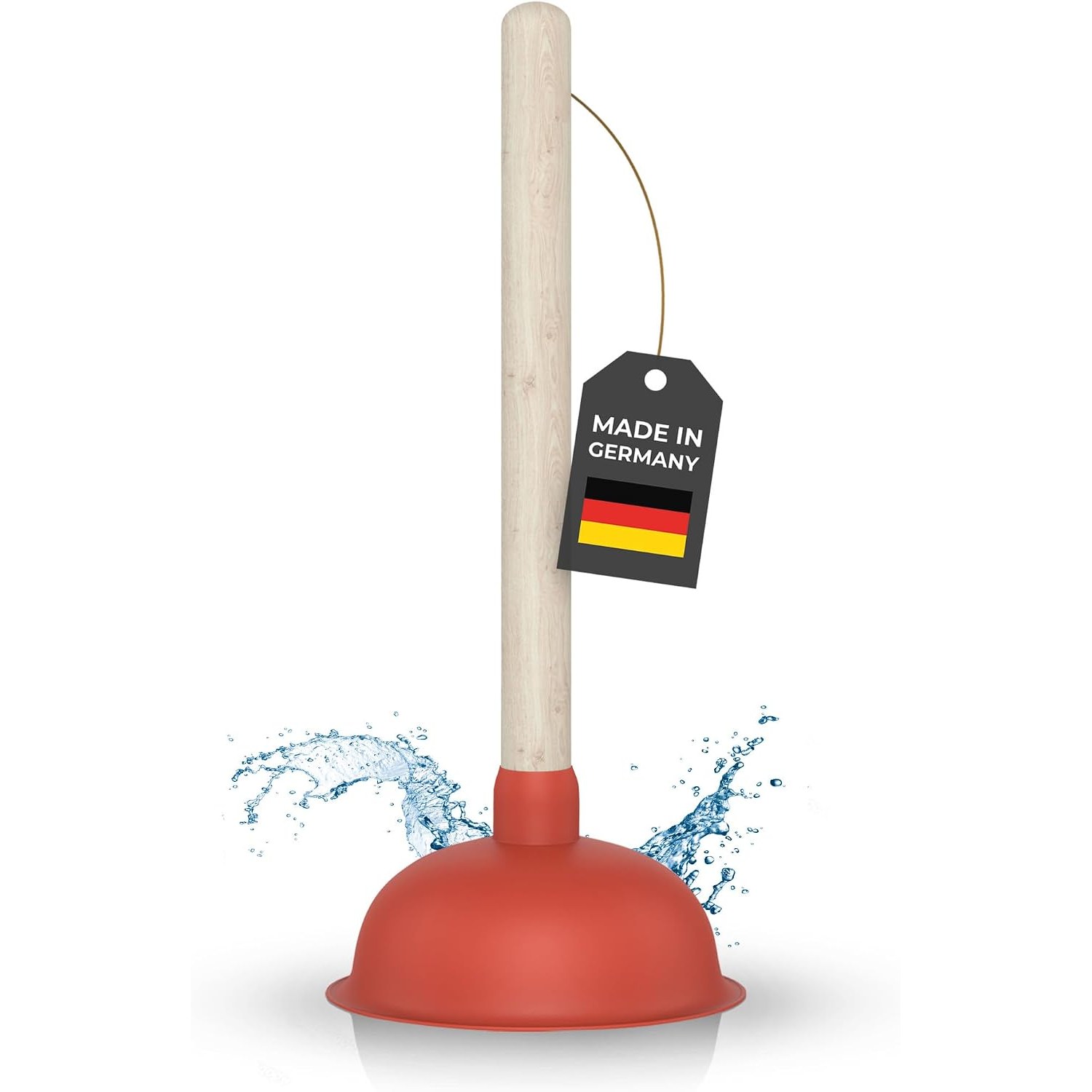
This one is 140mm, which is 14cm across. That is wide enough to span a standard kitchen sink waste with room to spare, and it covers bathroom basins and shower wastes comfortably. It also sits over the outlet of most household toilet pans. For a single-plunger household, that range is the sweet spot. A small 80mm cup is fine for a basin but useless in a toilet. An oversized industrial cup will not sit flat in a shallow basin.
There is one caveat worth knowing. If your toilet has an unusually wide opening, wider than the 14cm cup, the seal will be harder to form. The fix is water volume. Pour in a full bucket of water before you start, so there is enough body of liquid for the cup to work against. Flushing while the cup is seated can also help build pressure. It is not elegant, but it works.
The overall length here is 33cm, which gives a handle long enough that your knuckles stay out of the water on a filled sink. The whole thing weighs 200g, so it is not something you need both arms for.
Who this suits
If you rent, this is one of the first things worth owning. A plumber call-out for a blocked sink costs many times the price of a plunger, and most of the time the plumber will arrive and plunge it.
If you own an older home, pipework that has been in the ground for decades tends to have rougher internal surfaces where grease and soap catch. Those properties block more often, and a mechanical tool you can reach for immediately saves repeated chemical doses on pipes that may not love them.
Households with long hair should keep one in the bathroom permanently. Hair plus conditioner plus soap makes a dense felt-like mat in the shower trap, and it builds steadily until the day it stops the water. Catching it early with a plunger, before it compacts, keeps it manageable.
Families with young children have their own version of the problem, which usually involves too much toilet paper or something that was never meant to be flushed. A plunger handles the paper. Anything solid and foreign usually needs to come back out, not be pushed further in, so stop plunging if you suspect a toy or a toothbrush went down.
Anyone on a septic system should think of a plunger as the default first tool. Caustic cleaners kill the bacteria the tank relies on, and repeated doses cause bigger problems than the blockage did.
Getting a proper seal
Technique is worth two minutes of reading because it makes the difference between a clear drain and a sore back.
Start with water in the fixture. Enough to cover the rubber cup completely. If the sink is empty, run a few inches in. If the toilet bowl is low, add water from a bucket.
Seat the cup flat over the opening and press down slowly the first time. That slow first push squeezes trapped air out from under the rubber. If you start fast, you just blow air out and splash yourself.
Then work the handle. Fifteen to twenty strokes, keeping the cup planted the whole time, pushing and pulling with equal energy. Lift the cup and see whether the water level drops. If it does, run hot water for a minute to flush the loosened debris through. If it does not, reseat and go again.
Two small extras. On a double sink, plug the other drain with a wet cloth, because an open second outlet lets all your pressure escape. On a basin or bath, cover the overflow hole with a damp cloth for the same reason. Those two hidden air paths are the most common reason plunging seems to fail.
Looking after it
A plunger needs almost no maintenance, but the small amount it does need keeps it working.
Rinse the cup under running water after every use, with a little dish soap if it has been in the toilet. Wipe it dry rather than leaving it damp in a cupboard. A quick spray of household disinfectant after bathroom use takes seconds.
Store it so the cup is not squashed. Upright in a bucket or hanging on a hook is ideal. A rubber cup that spends a year flattened under a heavy box loses the shape it needs to seal properly.
Keep it out of direct sunlight and away from heaters. Heat and UV dry rubber out over time, and dry rubber cracks at the rim. Check the rim occasionally. When it stops springing back or you see splits, replace it, because a cracked rim cannot hold a seal no matter how hard you push.
When a plunger is not the answer
Be honest about the limits. If several fixtures in the house are backing up at once, the problem is in the main line, not the trap under one sink, and that is a job for a drain specialist. If water comes up in the shower when you flush the toilet, same conclusion.
If a single fixture refuses to clear after several rounds of plunging, the next step is usually removing the U-bend underneath and cleaning it by hand with a bucket positioned below. It is messier than it sounds but not difficult. Beyond that, a drain snake reaches further than water pressure can.
And if something solid went down, stop. Pushing a hard object deeper into the pipework turns a retrieval job into an excavation job.
The short version
A 140mm rubber cup on a 33cm handle covers the drains in a typical home, from the kitchen sink to the shower to the toilet. It clears blockages with water pressure instead of chemicals, which is kinder to old pipes and to septic systems, and it works in minutes rather than requiring a wait.
Get the seal right, use firm strokes both ways, block any second drain or overflow, and keep enough water in the fixture to cover the cup. Rinse it, dry it, hang it up. For 200g of rubber sitting under the sink, it is about as useful as a household tool gets.