
The complete guide
How to Choose and Use a Pressure Washer Pipe Cleaning Hose
The problem with a slow drain
A drain rarely blocks overnight. It slows. The sink takes a few seconds longer to empty, then a minute, then it stands full while you stare at it. Outside, the gully gurgles after heavy rain. By the time water is backing up, the inside of that pipe has been narrowing for months.
What is in there is usually boring. Cooking fat that cooled and stuck. Soap scum. Hair. Washing machine lint. Outside, it is leaf mulch and silt washed in from the yard. All of it clings to the pipe wall in a layer that gets thicker and rougher, which makes the next bit of debris stick even faster.
This matters because it explains why the usual fixes disappoint. A plunger shifts water. A chemical pours through the middle of the pipe and mostly washes away. A set of rods punches a hole through the plug, which gets the water moving again for a few weeks until the hole closes up. None of them scrub the wall. A jetter hose does, and that is the whole point of this kit.
How a jetter hose works
The idea is simple once you see it. You attach the hose to your pressure washer gun, screw a nozzle on the far end, and feed that end into the drain. When you pull the trigger, water comes out of the nozzle at high pressure.
The clever part is the direction of the jets. On the corner nozzle, one jet faces forward and three face backwards. The forward jet breaks into whatever is blocking the way. The three rear jets do something more useful. They act like tiny rockets, pushing the nozzle deeper into the pipe on their own, while their spray scours the wall and carries loosened muck back down towards the opening.
So the hose crawls along by itself. You are not shoving it. You feed it, control it, and let the water do the work. When you reach the end of the run, you draw the hose back slowly and the rear jets wash the wall on the way out too.
The rotary nozzle works differently. It spins as water passes through, so the jet traces a circle around the inside of the pipe rather than hitting one line. That is the one you want for a greasy coating or a layer of scale, because it gets even coverage of the full bore.
What this particular kit gives you
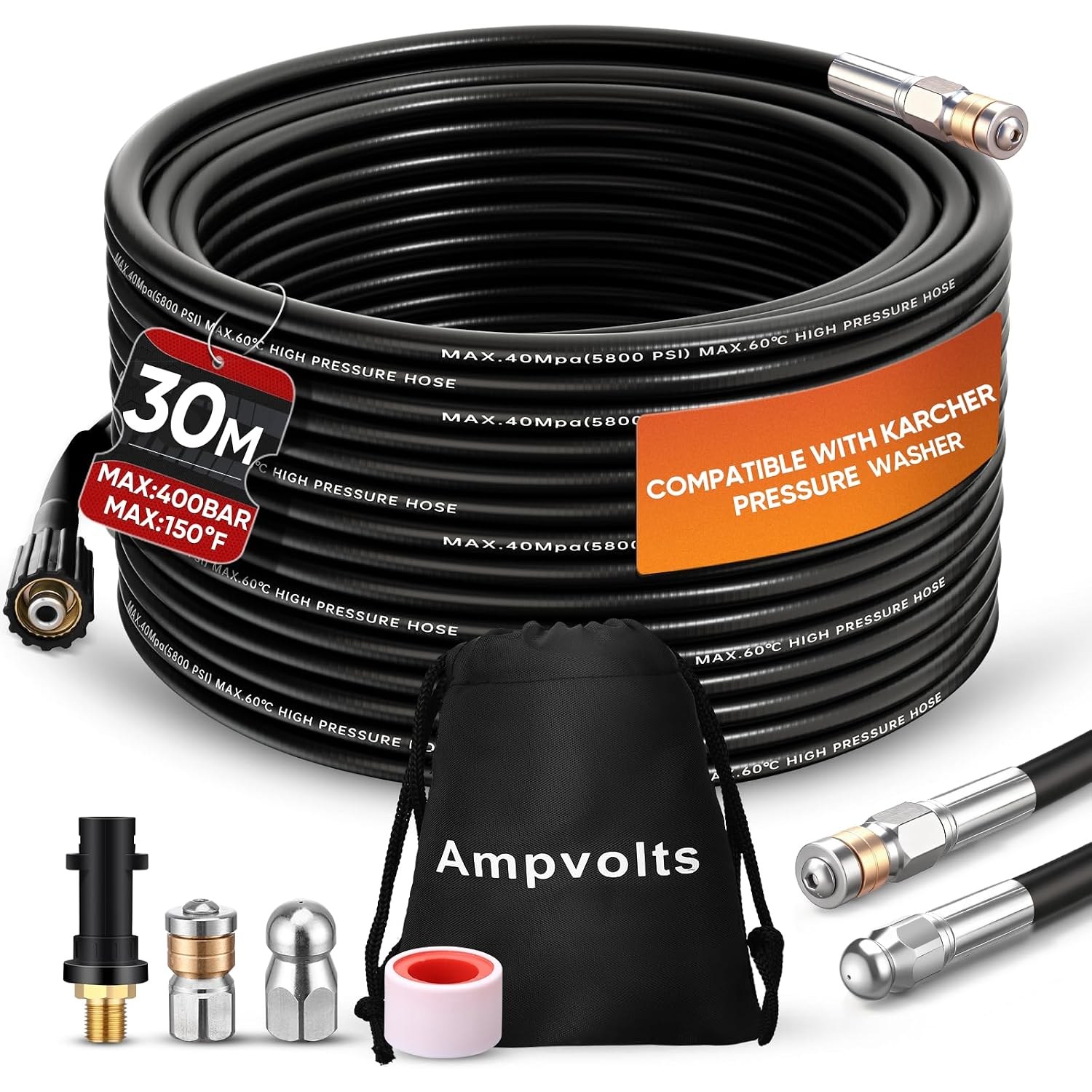
The hose is 30 metres long with a 0.25 inch outside diameter. That combination is deliberate. Thin enough to pass through household waste pipes and turn through gentle bends, long enough that you can work a complete run from one access point instead of digging up access halfway along.
Inside, it is three layers. The outer skin is PVC, which is there to survive being dragged over a concrete lip, across gravel, and in and out of a rough clay pipe. The middle is reinforced fibre, which stops the hose stretching or splitting under load. The inner tube is rubber, which carries the water. The set carries a maximum pressure rating of 400 bar.
The fittings are M22 14 mm female at the inlet and 1/8 inch NPT male at the nozzle. A standard adapter is supplied and suits common pressure washer guns, including Karcher K2 to K7 style connectors where the fitting matches. There is also a roll of waterproof thread sealing tape for the nozzle joint, and a drawstring bag so the whole kit lives in one place.
Who it suits
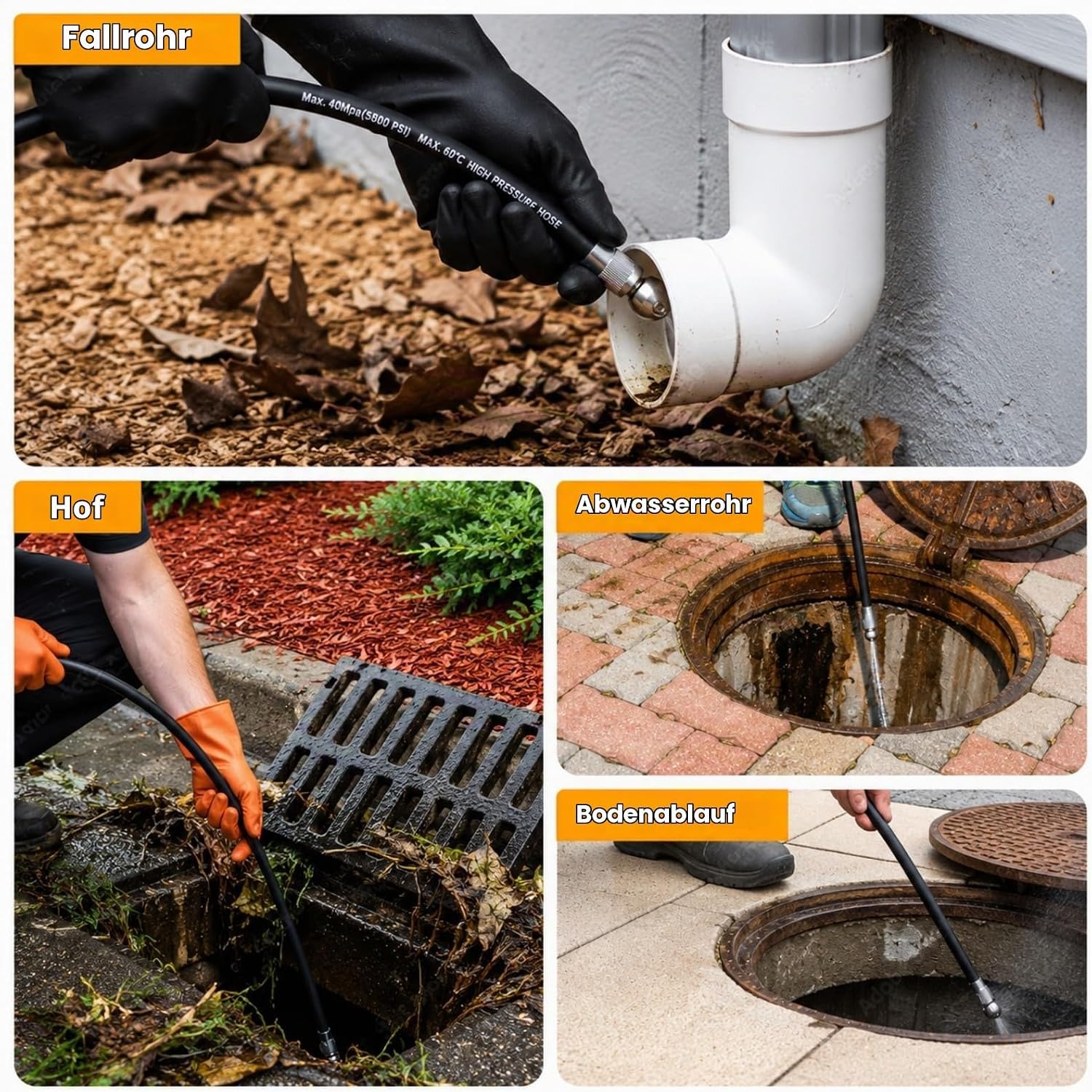
If you own a pressure washer and a property with its own drain run, this is for you. Houses with a long path from the kitchen to the boundary chamber, places with a gravel drive that washes silt into the gullies, anyone who has paid a drainage callout fee once and would rather not again.
It also suits small commercial users. Cafes with grease in the waste line, a workshop with floor drains, a landlord with a few properties who wants a tool in the van.
It is less useful if your only problem is a short sink trap. That is a job for a bottle brush or a hand auger, and you will spend more time coiling 30 metres of hose than you would fixing it. It is also not for car washing. The nozzles spray sideways and backwards, which is exactly wrong near paint.
Choosing the right nozzle for the job
Start with the corner nozzle when you have an actual blockage and need to get through it. The forward jet gives you something to break into the plug, and the rear jets give you the drive to keep moving.
Switch to the rotary nozzle for maintenance. If the drain already runs but you know there is a greasy film in there, the rotary nozzle will take that layer back without you needing to force anything. A lot of people run the corner nozzle first to clear, then the rotary nozzle on the way back to polish the wall.
One limit to know about. This hose works best in straight runs. Where your pipework has real bends, you want an internal diameter of at least 9 cm for the nozzle to turn through without snagging. Tight bends in narrow pipe are the main reason a jetter gets stuck.
Working safely
Three rules, and the first one matters most.
Never pull the trigger while the nozzle is outside the pipe. A nozzle with rear-facing jets at pressure will whip around hard. Push at least half a metre into the drain first, keep a hand on the hose where it enters, and let go of the trigger before you draw the nozzle back out past the opening.
Second, wear eye protection and gloves. Drain water sprays back, and it is not clean.
Third, check the hose and the fittings before every single job. You are looking for cuts in the outer layer, bulges, and worn threads. Fit fresh sealing tape when you re-fit a nozzle. A pressure hose that fails is not a small inconvenience.
The quoted working temperature range is 1.6 to 60 degrees Celsius. Warm water helps lift grease, but stay inside that band and inside whatever your own machine allows.
Looking after it
The habit that makes a jetter hose last is simple. Flush it after every job. Run clean water through the hose and both nozzles for a minute or two so grit and grease do not dry inside the bore. Those little nozzle jets are small, and a blocked one is useless.
Wipe the outside down, let everything dry, then coil the hose loosely. Do not fold it or force a tight loop, since kinks damage the reinforcement layer over time. Everything goes back in the drawstring bag, which keeps the nozzles with the hose instead of lost in a shed drawer.
Store it out of direct sunlight and above freezing. If water is left inside and freezes, it can split the inner tube. Drain it before cold weather and you avoid that entirely.
The short version
A pressure washer pipe cleaning hose is the one drain tool that actually removes build-up instead of poking through it. This kit gives you 30 metres of three-layer hose rated to 400 bar, a rotary nozzle for scouring the wall, a corner nozzle that drives itself into the pipe and flushes debris back out, plus an adapter, sealing tape and a storage bag.
Check your gun's connector first. Use it on straight runs, allow at least 9 cm internal diameter through bends, and keep the nozzle inside the pipe before you squeeze the trigger. Flush it after every job and it will be ready the next time the sink starts to stand.